Monday, 28 March 2016

Slices of Space

Hello again! It's been ages since the last post... Anyway, today is an update on my research project and the life as a Masters student battling with software and variable motivation. I've tried to put links to all the sciency bits to help explain.

This little piece of rock is roughly 4.6 billion years old. That's 4,600,000,000 years. It's a type of meteorite known as a 'howardite', which are made from the broken pieces of lots of rocks. I bought it from eBay, which according to my adviser is one of the best places to buy samples from. This particular one is NWA 1929, and is officially cataloged here. It weighs less than a gram, but I still think it's pretty cool. 

Now, why did I buy it?

Well, that's because I'm doing an independent research project for my final year of my MGeol degree. Oh, MGeol is an integrated geology masters. The focus of my research is working out what sort of rocks there might be on Vesta. In particular, I'm looking at eucrites (pretty much space basalt) with a scanning electron microscope to analyse the minerals and textures in super high detail. 

First of all though, let's have a quick run-down on Vesta.
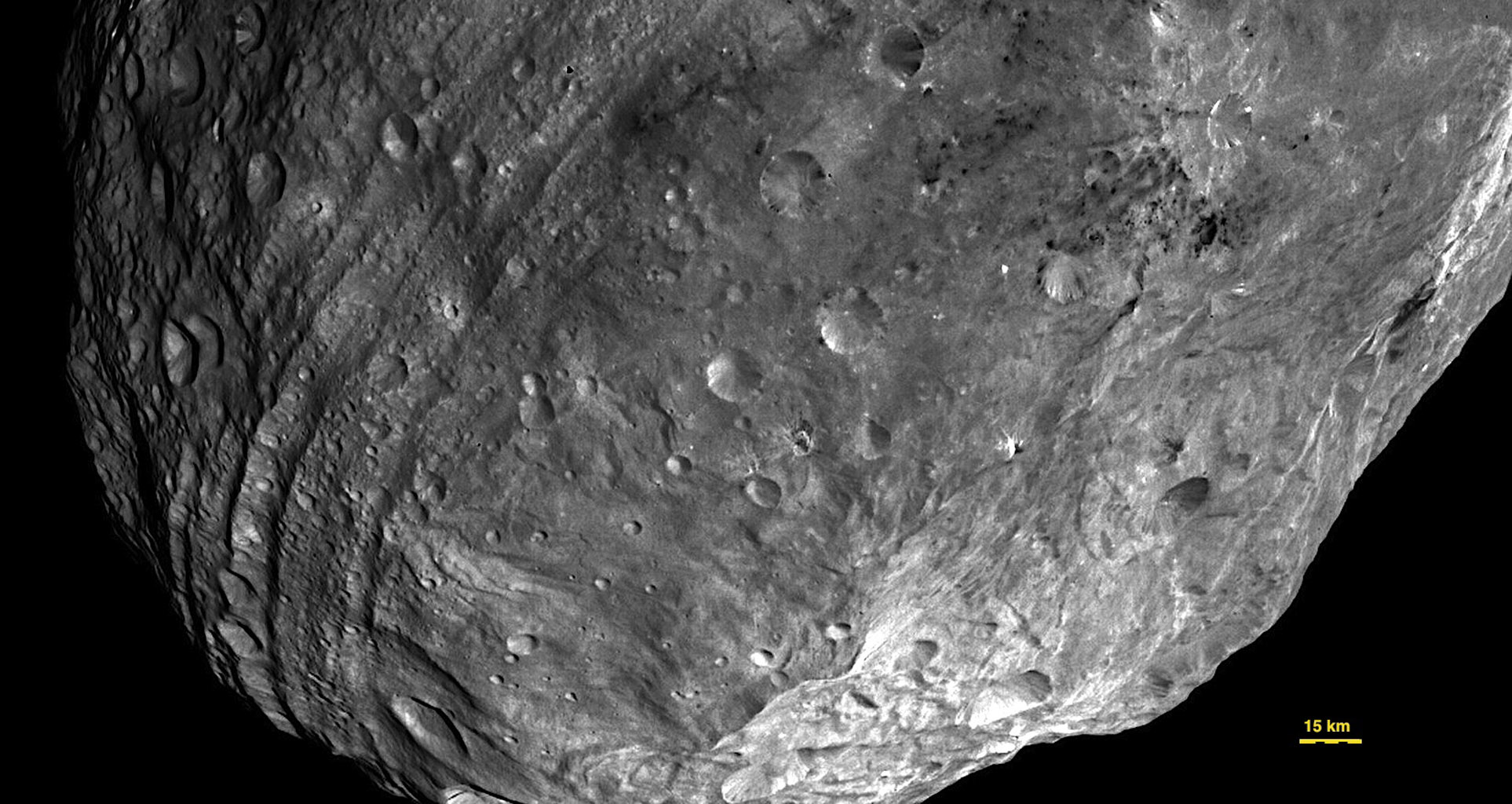
Vesta is a proto-planet in the asteroid belt, and was first discovered in 1807. It is 'differentiated', meaning that it was able to form a crust, mantle, and core - just like Earth. 
However, it never made it to being a proper planet, and now hurtles around the Sun once every 1,325 days. Vesta is thought to be the parent body for many HED meteorites. These are all igneous rocks, similar to basalts and gabbros on Earth. These meteorites were launched from the surface of Vesta by impacts from other bodies in the asteroid belt, particularly in the Rheasilvia Basin at the south pole of Vesta. This basin is a 500km impact crater that gives Vesta a bit of a funny shape at the bottom.

Anyway, NASA launched the Dawn mission in 2007, which arrived at Vesta in 2011 and orbited for a year or so before moving onto Ceres. Currently, Dawn is here.

Dawn was able to send back a load of data, including images, infra-red, and gamma ray data. From that, scientists have been able to make a rough geological map of Vesta, as well as studying the various craters, rock types, structural features, and think about how it formed. 

If you fancy it, there is a load of scientific literature available on all of Dawn's data. I recommend ScienceDirect or Google Scholar as an easy to find things to read, but just be warned that a lot of papers are behind a paywall, so you might only be able to access the abstracts or view it simply on the webpage. At the very least, take a look at NASA's website for the Dawn mission. There are loads of photos, nicely explained science, regular updates, and videos. 

Right. Back to my project.

Like I said, I'm using scanning electron microscopy (SEM) to study what each meteorite sample is made from in terms of elements, and then minerals. It's been good fun so far, but there's been a few problems too. 

Step 1. Sample Prep
Most of my samples came as thin sections - 0.03mm slices of rock stuck to a glass slide for use in microscopes. The benefit of thin sections is that they can go straight into the SEM after they've been coated in a thin layer of carbon and stuck down with copper tape, like this...
Some of my samples came as little chunks of rock like the one right at the start of this post. These ones have to be put into resin and polished by hand and by machine using various diamond pastes. This takes much longer than I'd like it to. Once they're all nice and shiny, the resin blocks are coated in carbon and can be used in the microscope.

Step 2. Data Collection.
Data collection is probably the easiest bit, actually. Driving the microscope is really good fun, and it's nice to see images and data in real time, rather than having to wait hours. You start off by finding an interesting looking area and spending what feels like 3 days of your life focusing the microscope. I'm using a JEOL 5001 FEG SEM, which can go up to over 1 million times magnification, although I rarely go about 850x. 

To start with, you get an EBSD image. This gives you a black and white picture of the sample, and can be used to look at texture and topography.
Different minerals show as different shades of grey, which is useful for the next stage of analysis.

Once you have your EBSD image, you wheel yourself across to the next computer to start analysing the composition. I'm using software called AZtec, which is only occasionally infuriating. Anyway, once you tell it to start mapping the area you've selected, you end up with something like this...
And yes. The colour schemes will always be hideous.

From there, you can run all the analysis you need to, and save several tens of gigabytes to your hard-drive and you're done! You can also make lots of spectral graphs, which are useful for telling you how much of each element there is.

Occasionally I get to run maps of the whole sample overnight or over the weekend which gives massive file sizes, but a really good representation of what your sample looks like. This is one of Millbillillie, which I affectionately refer to as Millie.
I got lucky with the colour scheme on that one. Never been able to replicate it.

Step 3. Analyse that shit!
Right. You've got your images and your data. You've exported it in every possible format. You've waited days for it to stick all the individual pictures together into one big picture. Good. Well done. Now it's time to make sense of all those numbers and spectra.

First things first, modal abundance. This is how much of each element there is in your sample. Now, AZtec will give you some numbers for this, but it's good to double check. You can do this in photoshop of all things. I downloaded a 30 day trial just to do this. It's highly frustrating and very bad for your eyes, but it seems to work well enough. As a bonus, sometimes you make really nice images that show certain things. For example, this one shows the texture of the sample really well. The stripey bits are caused by exsolution.

Spreadsheets are always fun. I have far too many of them now, but they are useful. The main thing I'm currently working on is identifying all the minerals that I've got spectral data for. I do this by looking at the ratios of different elements, and reconstructing them into formulas, and then into minerals. For example...
Now repeat several hundred times.

This is the stage I'm up to at the moment. 

Step 3. Write the damn thing.
We're given a guideline of 10,000 words, but also told that it should be suitable for a relevant publication. This means that some people will write 2 sides of A4, others (like me) will be writing up to 30 pages or so. 

Step 4. Presentation.
The final stage of my project is a small presentation to staff members about my project, and answering their questions. I'm probably the least stressed about this bit. I really enjoy presenting, and I really like my project. The key to a good presentation is being interested in what you're presenting.


So that's where I'm at. I've a few data sets that don't work properly - as in there are holes in the data and so on. That being said, I feel like I'm doing well and I'm on track at the moment. I struggle to get motivated sometimes, especially as I'm now just processing data and reading papers. I think it'll be fine.

Wednesday, 10 February 2016

4.6 Billion Years


I'm a geologist. Yeah. Rocks and stuff. Yes, I've heard that pun before. I've heard all of those puns before.

That's a pretty standard conversation with anyone who isn't a fellow geologist, although we do love a good rock-based pun. Today, I want to chat about why I love geology so much, and my independent research project that I'm currently working on. I'm a 4th year at university, and have moved from Earth-based geology to space. I study meteorites and asteroids now.

People often look down on geologists, and I had that from my own family, but often it is because they don't really know what we do and how much we know. What could be interesting about rocks, right?


I am constantly astounded by the world around me. We take so much for granted, but we are standing on a tiny ball of rock that is hurtling around the Sun which is in turn hurtling through space, and it has survived for 4.6 billion years. You can walk through landscapes and touch rocks that are older than mankind by millions of years. You can pick up a pebble that was there at the time of the dinosaurs. You can see ancient sea beds and volcanoes and rivers and life. You can reconstruct the past on a grand scale. You can see how our Earth has changed and developed, and you can imagine what it will look like in the future.

Geology is a wonderful tool of understanding. It teaches you to think in bizarre time-scales - where a million years is pretty damn fast - and you start to view the Earth as a complete system that has been working since long before we were here and will continue long after we've gone.


It's also great to study at university. It's a field science, so you get to go to different places, and you can learn from people that are equally passionate. We form incredibly strong bonds over pints in the pub and sheltering under trees on mountains. You'd be surprised how much fun you can have in the rain whilst standing next to an outcrop for scale.

I cannot imagine myself doing anything else. I love being able to see and understand the history of the world by walking through it. The Earth is old and it is beautiful. 

Right. Enough of that. Let's talk about space. 


Until May, I'll be working on an independent research project looking at using actual meteorite samples to discern rock-types on an asteroid some 251 million km away from Earth. I think that's pretty cool. I'll be using a Scanning Electron Microscope (like a normal microscope but uses electrons rather than light, and can detect elements) and data sets from NASA's Dawn probe. The asteroid I'm studying is Vesta - the 4th asteroid to be discovered. I'll write a post about Vesta at some point because it is really interesting, and we have some stunning images of it now.


I had never expected to turn to planetary geology, as this is, but I have always been fascinated by space. I suppose it isn't all that surprising really. In geology, we can see millions and millions of years of history. In planetary geology and space science, we can see billions. Studying meteorites and asteroids give us a window into the early Solar System (and it means you get to touch something that is 4.6 billion years old and came from millions of miles away). This area of research is very much curiosity-driven, which is no bad thing. We live in an extraordinary place, and it is only natural that we want to know more.

I'm so happy to have the opportunity to do this research now. Perhaps I should have chosen a project that would put me inline to work in industry, but this is a chance I might never get again. I had never thought I'd have to carry 10 different meteorite samples with me to university, let alone spend all my time studying them and trying to draw new conclusions and ideas. 

I guess the main thing that I want you to take away from this is that it's OK to choose to do something because it's fun. It's OK to be passionate. It's OK to be a little weird in the eyes of others. Your interests are valid, and it's your life to do with what you want. If it's something that you want to do, then do it. It is better to try than to spend your life regretting it. This applies to so many things. 

Be enthusiastic. Be passionate. Be interested. Be amazed and search for things that will stun you with awe.


Saturday, 23 January 2016

Iceland 4.0 - Into the Heart of a Glacier

I got back from my 4th trip to Iceland on Thursday. This was my first time visiting the country in winter, and my first time on this section of the coast road, although it was only a very short holiday. In short, it was beautiful. The rest of this post will go over it in a little more detail, and hopefully the photos will be able to express some of the wonderful things that I have seen.

My tour was organised through Discover the World, who I generally highly recommend but unfortunately this time I had a few issues. Nothing too major, but it caused me a bit of stress that I could have done without. I flew out from Heathrow T2 on Monday and landed at Keflavík airport mid-afternoon. Keflavík is Iceland's international airport, and is about an hour away by coach from the capital city Reykjavík. The coaches, taxis, and minibuses are right outside the entrance/exit, and you can easily buy tickets for them just before you leave the airport building. 

I spent my first night in Reykjavík at Hótel Klettur I'd highly recommend it as a hotel. It's an easy walk to the high street and is near to the motorway in and out of the city so it is very accessible. The rooms are nice and spacious, and are always clean. I've stayed there on previous trips, and have never had any problems with them. The staff are lovely and incredibly helpful (as I found out when I had to book a taxi to the airport in a hurry on my way home).

Rather than eating in the hotel restaurant, I had a quick walk along the high street and decided to eat at the Old Iceland Restaurant. It's quite small, but they were able to seat me with no problems. The menu has a good range of Icelandic and fusion dishes, and it is really well priced. I went for the Icelandic seafood soup, which was delicious and had properly large chunks of fish. There's something very comforting about traditional Icelandic food for me (excluding fermented shark), as it isn't overly fancy, but is incredibly tasty and filling.

On the Tuesday, I was picked up from my hotel by my tour guide Kristian from Arctic Adventures and the rest of the group I'd be travelling with. We drove out of the city to our first stop - Seljalandsfoss.

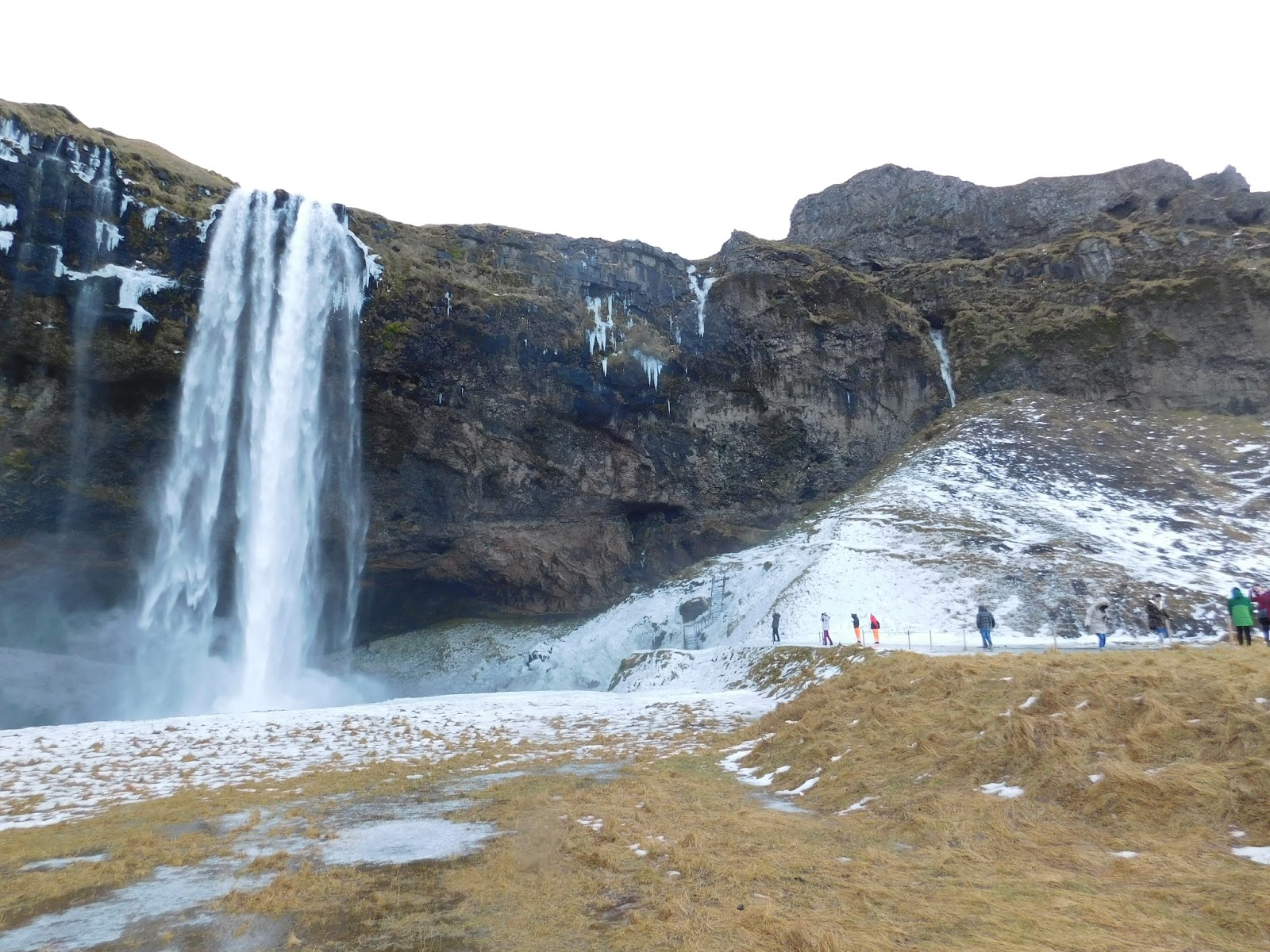
Seljalandsfoss is a 65m waterfall that drops over the old coastline of Iceland. During the last Ice Age, the weight of the ice over Iceland weighed it down. When it melted, the country lifted which means that the old coastal cliffs are now inland and very high, so there are lots of waterfalls. You can actually walk behind Seljalandsfoss, but only if you're prepared to get wet! When I was there, the path was far too icy to do it safely although a few people did manage it. The following photos are of the waterfall and the scenery that you can see from it.


Next was Skógafoss, another waterfall a little further up the coast. 
Skógafoss is similar to Seljalandsfoss in that it falls over the old sea cliffs, but you can't walk behind this one and it is much wider and a little shorter. Either way, I think it is much more impressive, and has featured in Sólstafir's "Fjara", Thor, and The Secret Life of Walter Mitty. The river comes from the Eyjafjallajökull glacier, which is an outlet glacier of Vatnajökull and was put on the map after the volcano beneath it erupted in 2010.

The last stop of the day was Reynisfjara - a black sand/pebble beach with a cave of lava columns called Hálsanefshellir. Reynisfjara is the southernmost beach in Iceland, and is notorious for sweeping tourists out to sea. There are also a set of stacks a little out to sea that are known as Reynisdangar, and are made of two trolls and a 3-masted ship according to legend. 
From the beach, you can also get a really good view of the mountains and the glacier inland. I was fortunate that we had good weather when I was there, and we were at the beach near sunset so the light on the snow was really pretty.

We stayed in Hótel Skaftafell for the night and had a really good meal there. Unfortunately, there were no Northern Lights, so I was able to get an early night after watching a bit of the handball match that our guide had told us about. It's a silly game, really, but it's quite entertaining. Anyway, because we arrived a night we didn't know what the area around the hotel looked like until the sun came up at around 10am the next morning (Wednesday). Apparently, the hotel is surrounded by mountains, and dawn was really rather lovely.


Wednesday was the day I'd most been looking forwards to because we got to go to the famous glacial lagoon. 
Jökulsárlón is perhaps the most beautiful place that I've ever been to. It is a lagoon formed from the retreat of the Breiðamerkurjökull glacier - another outlet of Vatnajökull - and is nearly 250m deep! The ice breaks off from the glacier and floats as ice bergs through the lagoon, before making its way to the beach. Jökulsárlón is stunning, and definitely worth a visit if you have time. If you're lucky, you can even see seals swimming in it.

At around 11am, we met up with a different tour guide for our next stop. This time, it was Nick from Glacier Guides, who took us up to an ice cave in the Vatnajökull glacier. We got there by an Icelandified minibus, which effectively is a minibus with a bigger engine and massive wheels. I'm a big fan of the super jeep and it's extended family, so I was really rather happy.

The ice cave has a very ethereal beauty, and is completely natural. The only man-made addition was a rope to help you get down into it, and a spade used to clear the snow out when needed. These caves form in the summer when the melt water leaves the glacier as a river. In the winter, the glacier isn't melting (at least not as much), so it is sometimes possible to access them. Please don't go hunting for them by yourself though!

Anyway, the ice in the glacier is blue because it is so compacted that the vast majority of the air in it has been pushed out. It is wonderful to experience, and really quite surreal. In the cave, you can see small pebbles and bands of ash, dirt, dust, and gravel that have been caught in the ice during the glacier's development and movement.

Once we were done at the cave, we rejoined our original guide at the lagoon before crossing the road to go to the ice beach at the end of Jökulsárlón. 
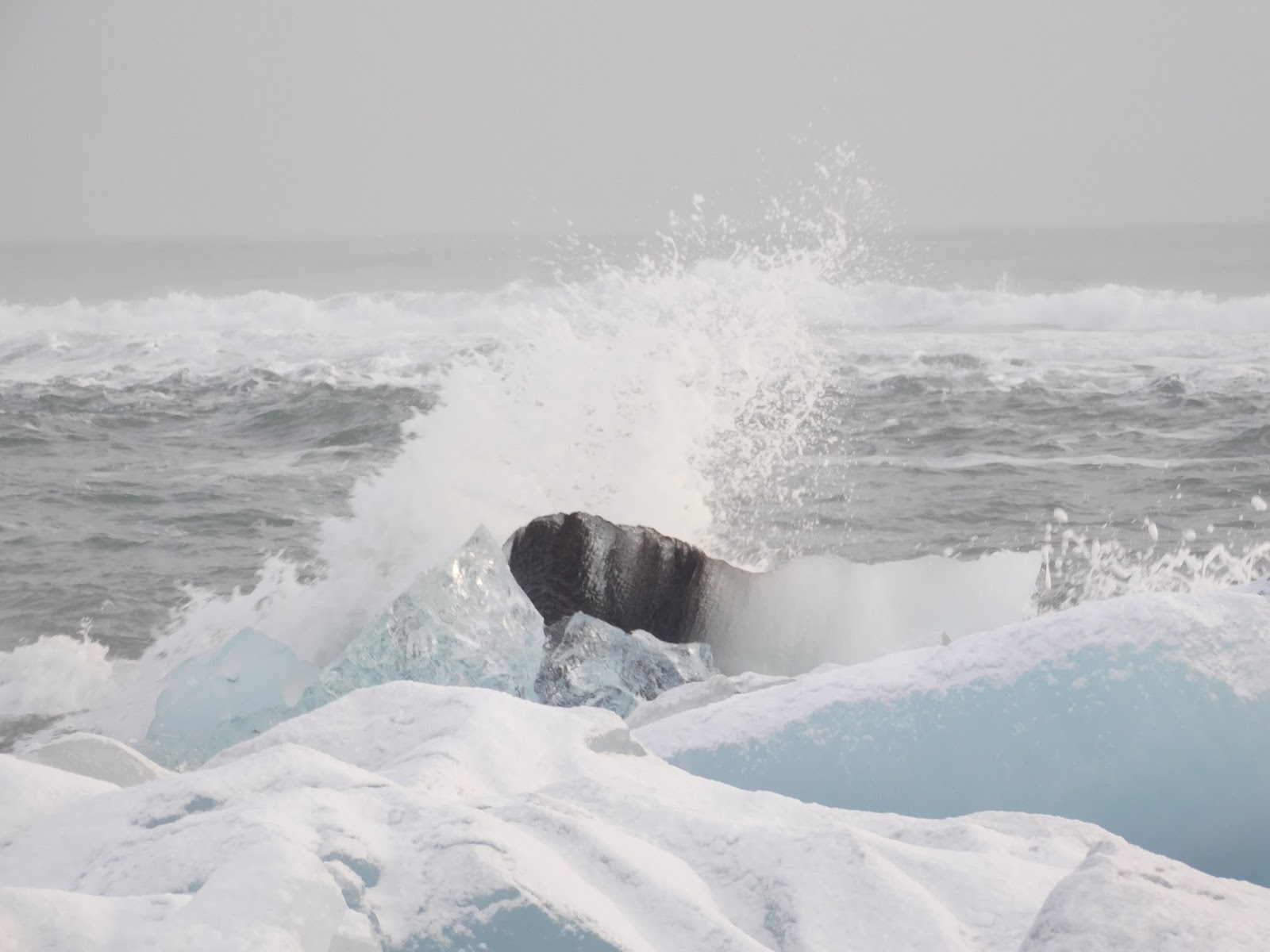
The ice bergs in the lagoon never really make it out to sea because they are washed back onto shore by the waves. Also, at low tide the flow of the river out of the lagoon reverses, so some of the ice bergs are swept back up into the lagoon. The beach itself is beautiful as well, and much safer than Reynisfjara (provided you don't go clambering too near the water's edge). We were there as the sun was setting, and thanks to the cloud the light was really soft and incredibly atmospheric.

The last proper stop of the tour was Fjaðrárgljúfur - a 100m deep canyon carved out through layers of tuff and palagonite by the river Fjaðrá. We arrived as it was going dark, so the pictures aren't the best. Despite the lack of light, the canyon has a distinctly Icelandic feel to it, and you can get a good view down to the coast from it. According to our guide, it is very popular for swimming and walking in the summer, and I imagine that it must be beautiful.

After Fjaðrárgljúfur, we headed back to Reykjavík. Kristian recommended that we go for a group meal in the town where he went to college, so we did. It was a good choice. He booked us a table with a set meal of lamb/cod and dessert for 5900kr at Tyrggvaskáli in Selfoss. The food was glorious, and the restaurant has a nice feel about it - almost as if you're eating in someone's house! I was also very impressed by their selection of teas...

So, that was that. We were dropped off at our respective hotels in the city around 11pm, so I was exhausted. I got another good night sleep at Hótel Klettur, and woke up in time to watch the sun rise at the near Harpa by the waterside. It was hellishly windy though, so it was near impossible to take a photo that wasn't blurry.
Following that, I headed up the high street to Hallgrímskirkja - the iconic church that marks Reykjavík's skyline. It wasn't the best day to get photos of it, and the lighting made it a challenge...
I had lunch at Cafe Loki, which is just opposite the church and serves traditional Icelandic food. I avoided the fermented shark as I've tried it before, but I did the pleasure of watching a pair of middle aged Brits try it. If anything, I think they preferred the shark to the Brennivin. I played it safe and had a slice of homemade rye bread with plokkfiskur (mashed fish, potato, and egg), and their own blend of tea. It was made primarily of birch and arctic moss, and it was really rather nice.

I spent a little bit of time wandering up and down the high street, mostly to find all the paintings on the buildings. This year, I found two new ones, both of which were Viking themed.

Eventually, it was time to go home. After a bit of a kerfuffle with a bus not showing up, I got a taxi to the airport and had a very good chat with the taxi driver. The ride was 13,000kr, which was actually pretty reasonable and it was a much nicer and faster ride than on a bus, so I'll definitely use a taxi from now on. In the airport, I bought a bottle of Vor Icelandic Gin as a souvenir (I like gin and it was recommended to me), as well as some chocolate for my parents.

All in all, it was a wonderful trip. I got to see some of the places that I've been dreaming of for years, and they did not disappoint me. I am always happy to spend time in Iceland, as I feel incredibly at home there. The people are lovely. The culture is wonderful. The landscape is awe inspiring.

I always recommend Iceland to people who are looking to travel. It is a great way to see an unusual part of the world with a unique culture, in a very friendly and easy environment. As long as you're prepared to wear warm clothing and a waterproof, you'll be fine.

ALL PHOTOS AND GIFS WERE TAKEN AND CREATED BY ME

26.01.2016
I compiled a load of footage from my trip to make this video. Please enjoy.


Template developed by Confluent Forms LLC; more resources at BlogXpertise